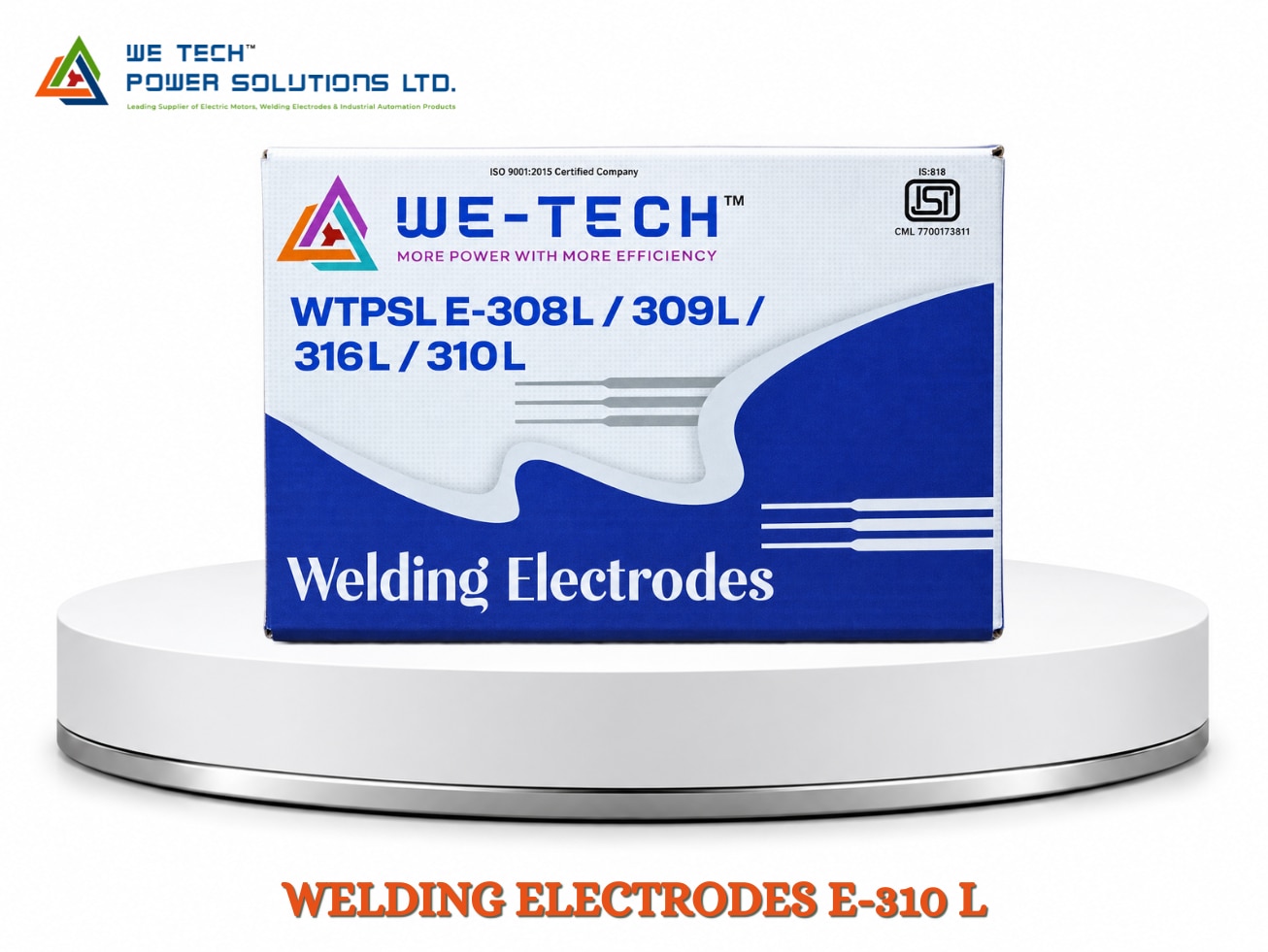
WELDING ELECTRODES E-310 L
Description
Welding Electrodes E-310 L Supplier in Gujarat.
We Tech Power Solutions Ltd, offer Welding Electrodes E-310 L in Ahmedabad for specialized stainless-steel welding applications where high-temperature performance, oxidation resistance, and dependable weld quality are important. E-310 L electrodes are extra-low-carbon austenitic stainless-steel electrodes designed for welding 25% chromium and 20% nickel alloy systems, including applications involving AISI 310L materials.
Technical Highlights
• Electrode Type: Extra-low-carbon austenitic stainless steel
• Typical Chromium: Approx. 25%
• Typical Nickel: Approx. 20%
• Carbon: Typically ≤ 0.04%
• Temperature Resistance: Approx. 1,150°C–1,200°C*
• Current: AC / DC+ (DCEP), subject to product specification
• Structure: Fully austenitic weld metal
• Main Uses: High-temperature, process and dissimilar-metal welding
Composition and Key Properties
As a Welding Electrodes E-310 L Supplier in Gujarat, We Tech Power Solutions Ltd provides electrodes designed to produce a fully austenitic weld metal containing approximately 25% chromium and 20% nickel. The extra-low carbon composition, typically up to 0.04%, helps reduce carbide precipitation and supports the intended corrosion and high-temperature characteristics of the weld deposit.
High-Temperature and Corrosion Resistance
The Welding Electrodes E-310 L Exporter from India range is suitable for applications exposed to elevated temperatures. These electrodes resist oxidation and scaling at temperatures up to approximately 1,150°C–1,200°C, depending on service conditions and material selection. They also resist intergranular corrosion, nitric acid, and certain stress environments.
Current Compatibility and Welding Usability
For customers looking for Welding Electrodes E-310 L Dealer in Kuwait, these electrodes can typically be used with Alternating Current (AC) or Direct Current Electrode Positive (DC+ / DCEP), depending on the specific product and approved welding procedure. Proper current selection, electrode handling, and welding technique are important for achieving a sound, consistent weld.
Common Industrial Applications
Welding Electrodes in Qatar can be used for several demanding industrial applications. In process industries, they are used to manufacture and repair heat exchanger tubes, piping, and vessels exposed to nitric acid or ammonium nitrate environments. Other applications include furnace components, oven linings, heat-treatment boxes, and gas-turbine combustion components.
Applications at a Glance
• Heat exchanger tubes
• Process piping and vessels
• Nitric acid and ammonium nitrate equipment
• Industrial furnace components
• Oven linings
• Heat-treatment boxes
• Gas turbine combustion components
• Dissimilar metal welding
• Hard-to-weld steel applications
Recommended Welding Practices
Good welding technique is important when working with Welding Electrodes E-310 L. Because the weld structure is fully austenitic, controlling heat input can help reduce the possibility of hot cracking. Stringer beads, a short arc, and appropriately controlled amperage are generally recommended. If electrodes have been exposed to moisture, re-drying at around 250°C–300°C for approximately 1–2 hours may be required, subject to the manufacturer's instructions.
Contact We Tech Power Solutions Ltd for Welding Electrodes E-310 L and discuss your stainless-steel welding requirements.
Top 3 FAQs
1. What are Welding Electrodes E-310 L used for?
They are used for high-temperature stainless-steel welding, furnace components, process equipment, heat exchanger tubes, piping, vessels, and selected dissimilar-metal applications.
2. What makes E-310 L different from standard E310 electrodes?
E-310 L has an extra-low carbon composition, typically ≤0.04%, which helps reduce carbide precipitation and supports corrosion performance.
3. Can E-310 L electrodes be used with AC and DC?
Many E-310 L products can be used with AC and DC electrode positive, (DCEP), but always follow the manufacturer's product data and approved welding procedure.