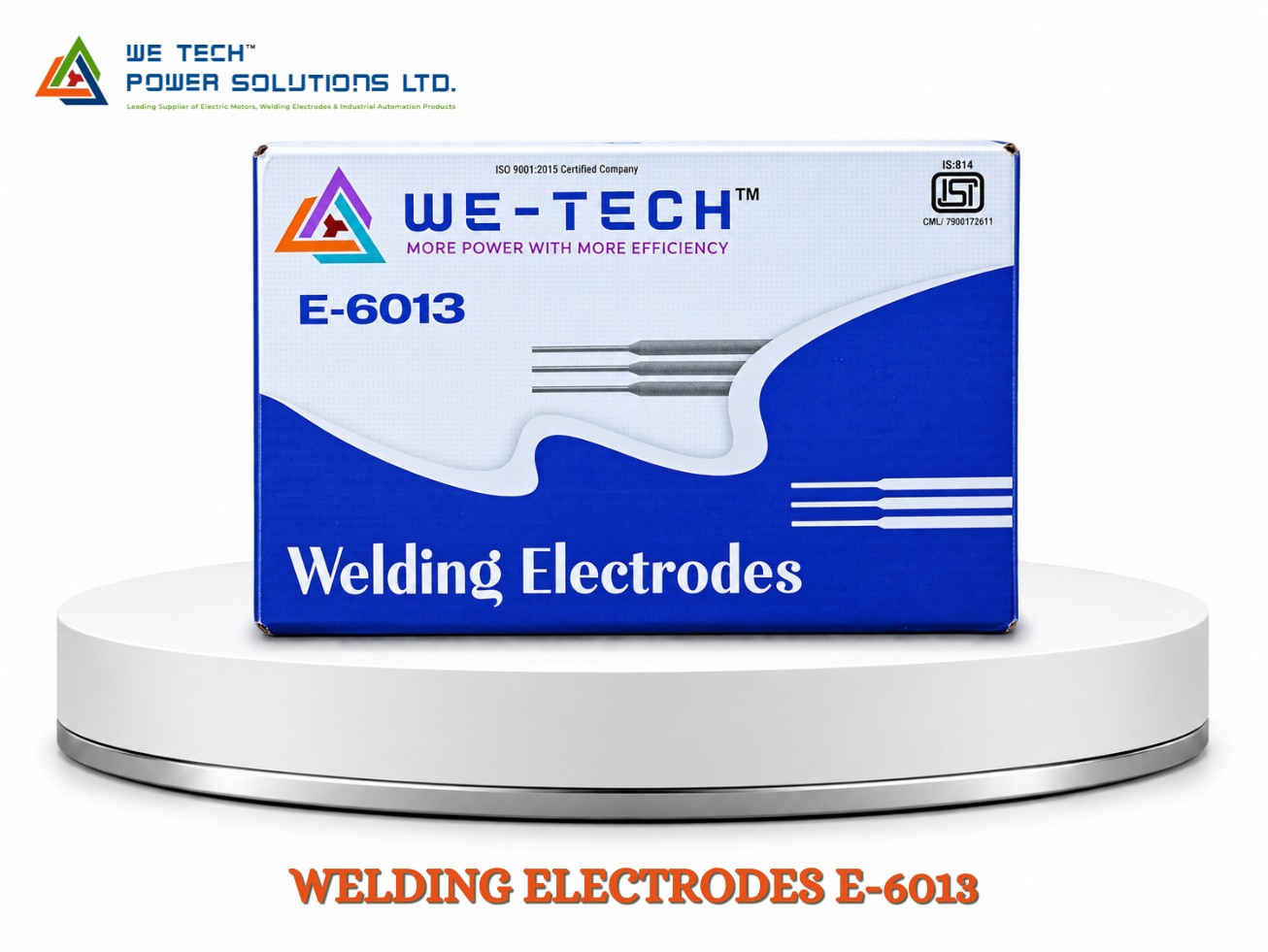
WELDING ELECTRODES E-6013
Description
Welding Electrodes E-6013 Trader in Ahmedabad.
We Tech Power Solutions Ltd, supply Welding Electrodes E-6013 designed for smooth, stable, and dependable welding across a wide range of structural and fabrication applications. This rutile-coated electrode provides good arc stability, fine weld ripples, and easy slag removal. Its all-position usability makes it suitable for steel structures, tanks, truck bodies, ships, pipelines, bridges, and other general fabrication work.
Technical Specifications
· Electrode Classification: AWS A/SFA 5.1: E6013
· IS Classification: IS 814: ER 4211 X
· Coating Type: Rutile
· Coating Factor: Medium
· Identification: Name printed on electrode
· Welding Positions: All positions
· Special Position: Particularly suitable for vertical down
· Arc Characteristics: Good arc stability
· Weld Appearance: Fine ripples
· Slag Removal: Easy
· Weld Quality: X-ray quality welds, subject to proper welding procedure
E-6013 Welding Electrodes – Classification and Features
As a Welding Electrodes E-6013 Trader in Ahmedabad, We Tech Power Solutions Ltd offers electrodes classified according to AWS A/SFA 5.1: E6013 and IS 814: ER 4211 X. The electrode features a medium rutile coating factor and has its name printed directly on the electrode for easy identification. This practical identification feature helps operators select and handle the required electrode efficiently during fabrication work.
Smooth Arc and Easy Slag Removal
The Welding Electrodes E-6013 Supplier in Gujarat range is suitable for structural welding where consistent arc performance and a clean finish are important. Its stable arc produces fine ripples, and the slag removes easily after welding. The electrode can be used in all positions, with particular suitability for vertical-down welding, and is designed to produce welds suitable for applications requiring radiographic-quality results when the complete welding procedure is properly controlled.
Applications Across Steel Fabrication
For industrial customers seeking Welding Electrodes E-6013 Exporter from India, these electrodes can join steels such as A, B, C, and D grades of ASTM SA-283. Their application range also covers steel structures and tanks, truck frames and bodies, ships, pipelines, bridges and other fabrication requirements. Select proper welding parameters and joint preparation based on the base material and project requirements.
Chemical Composition
The Welding Electrodes E-6013 Dealer in United Arab Emirates (UAE) range has specified chemical composition limits that support its intended welding characteristics. The reference composition includes carbon up to 0.10%, manganese up to 0.60%, silicon up to 0.28%, sulfur up to 0.03%, and phosphorus up to 0.03%. These values should be considered as specified limits for the product and application requirements.
Chemical Composition
· Carbon (C): Maximum 0.10%
· Manganese (Mn): Maximum 0.60%
· Silicon (Si): Maximum 0.28%
· Sulphur (S): Maximum 0.03%
· Phosphorous (P): Maximum 0.03%
Why Choose E-6013 Electrodes?
For businesses sourcing Welding Electrodes in Saudi Arabia, E-6013 is a practical choice for general structural and fabrication work that requires smooth arc characteristics, manageable slag removal, and all-position welding capability. We Tech Power Solutions Ltd can help customers select the right welding electrode based on the material, welding position, and intended application.
Contact We Tech Power Solutions Ltd for E-6013 welding electrodes and discuss your welding application and supply requirements.
Top 3 FAQs
1. What is Welding Electrode E-6013 used for?
E-6013 electrodes are used for structural and general fabrication applications, including steel structures, tanks, truck frames, ships, pipelines and bridges.
2. What type of coating is used on E-6013 electrodes?
E-6013 uses a rutile coating with a medium coating factor, providing good arc stability and easy slag removal.
3. Can E-6013 electrodes be used in all welding positions?
Yes. E-6013 electrodes can be used in all positions and are particularly suitable for vertical-down welding.